
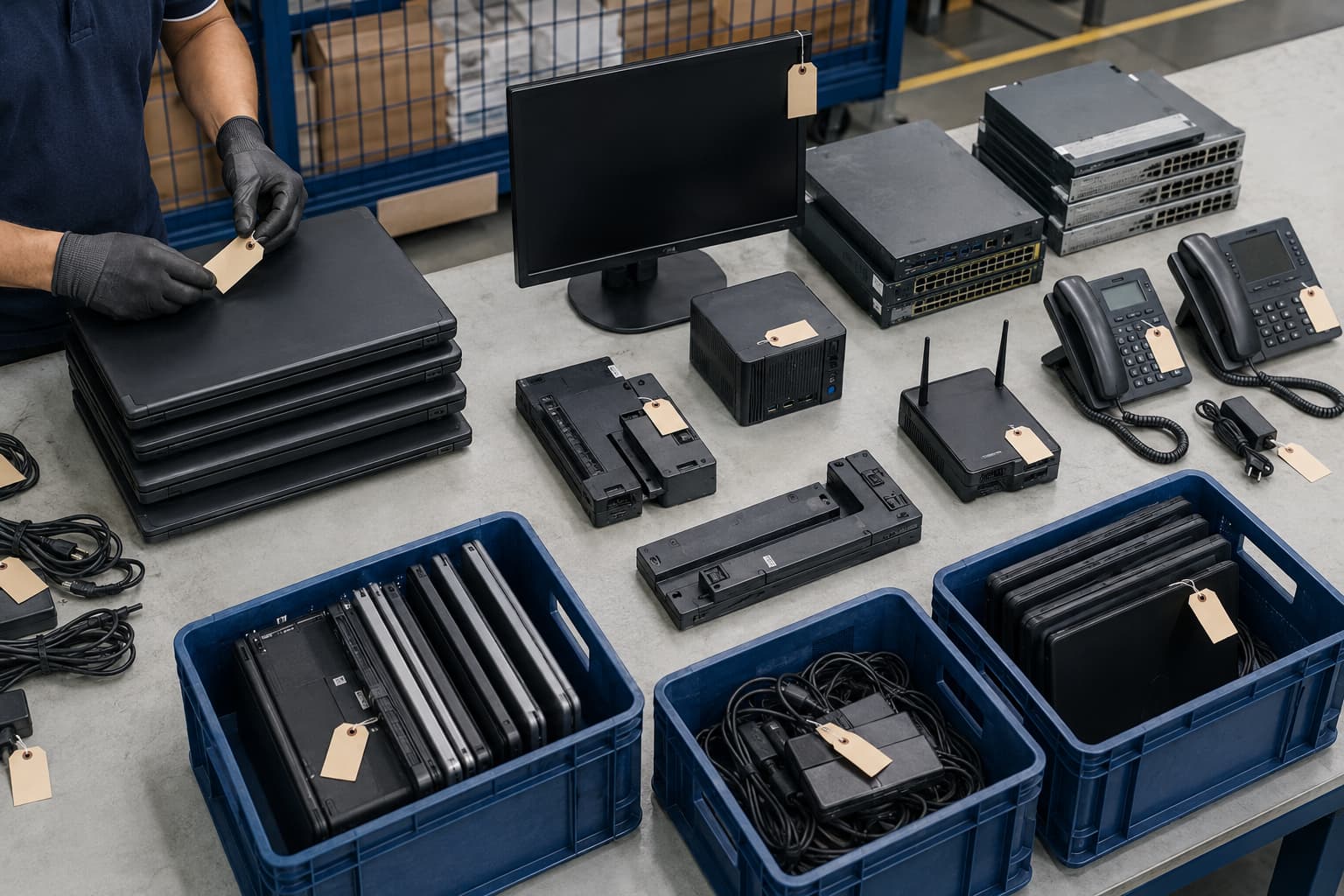
E-waste disposal for businesses in Singapore
Business e-waste disposal without losing track of the data.
Destruc collects unwanted business electronics, from laptops and monitors to servers and network equipment. We help define the data-handling requirement first, then move reusable and end-of-life equipment towards the appropriate next step.
- Business collections
- Data wiping or destruction
- Asset and serial records
- Certificate of destruction
After collection
Not every retired device should go straight to recycling.
A working laptop, an end-of-life monitor and a failed server drive are not the same job. The right route depends on condition, the data held on the equipment and your disposal requirements.
Condition and project requirements allow another use to be considered.
Data-bearing equipment is handled before it moves on.
Reuse is assessed before usable equipment is treated as waste.
Age, damage or condition makes continued use unsuitable.
Recycling the device does not remove the data requirement.
The equipment moves towards an appropriate material-recovery route.
The media has failed, is unsuitable for reuse or must be destroyed under policy.
The destruction method follows the scope agreed for the project.
The completed outcome can be recorded against the agreed asset detail.
The route is agreed before processing begins. Send a list, rough quantities or a few photos and tell us what your team needs to account for.
Equipment we can assess
What is waiting in the office, storeroom or IT room?
Business e-waste rarely arrives in one neat category. Use this list as a guide, not a fixed acceptance list. If an item is missing, include it in your enquiry and we will confirm whether it can form part of the collection.
A few clear photos and an estimated quantity are often enough for the first review.
Send us what you haveComputers and displays
Retired employee devices and display equipment from upgrades, office moves and accumulated IT stock.
Servers and storage
Data-bearing infrastructure removed during hardware refreshes, migrations or server-room clear-outs.
Network equipment
Connectivity and security hardware replaced during infrastructure upgrades or site consolidation.
Phones and mobile devices
Company-issued devices that may still contain user, customer or operational information.
Office electronics
Technology that tends to remain behind after a workplace refresh, relocation or closure.
Accessories and cabling
Mixed peripherals and supporting equipment collected alongside the main IT asset batch.
After collection
When does retired business equipment actually become e-waste?
Age alone does not answer the question. Condition, remaining usefulness and stored data determine whether equipment should stay in use, enter an e-waste scope or follow a separate media-destruction requirement.
The equipment may still have a practical use beyond its current owner.
Condition and data requirements should be considered before recycling.
A broader IT equipment disposal route may be more appropriate.
Condition or practicality makes continued use unsuitable.
Data-bearing parts and unusual items still need to be identified.
The confirmed end-of-life equipment moves towards recycling.
Drives, phones, servers and other devices may still hold business data.
The appropriate data treatment is agreed before material processing.
Recycling the hardware follows the agreed treatment of stored data.
The route is agreed before processing begins. Send a list, rough quantities or a few photos and tell us what your team needs to account for.
Choose the right service
E-waste disposal or IT equipment disposal—which fits your project?
E-waste disposal is for electronics that have reached the end of their useful life. IT equipment disposal covers the broader retirement of working, damaged and end-of-life business technology.
E-waste disposal
Focused on confirmed end-of-life electronics and the controls needed before recycling.
IT equipment disposal
Focused on retiring a mixed asset estate and deciding the appropriate route for each item.
The equipment is genuinely end of life.Your main need is business e-waste collection and a clear route towards recycling.
The batch contains usable or mixed-condition assets.You need a broader retirement plan rather than treating everything as waste.
Choose the right service
E-waste disposal or IT equipment disposal—which fits your project?
E-waste disposal is for electronics that have reached the end of their useful life. IT equipment disposal covers the broader retirement of working, damaged and end-of-life business technology.
E-waste disposal
Focused on confirmed end-of-life electronics and the controls needed before recycling.
IT equipment disposal
Focused on retiring a mixed asset estate and deciding the appropriate route for each item.
The equipment is genuinely end of life.Your main need is business e-waste collection and a clear route towards recycling.
The batch contains usable or mixed-condition assets.You need a broader retirement plan rather than treating everything as waste.
Singapore e-waste requirements
What does Singapore's e-waste system mean for your collection?
Singapore regulates e-waste under the Resource Sustainability Act, but the same duties do not apply to every organisation. Before clearing old electronics, establish your role, identify data-bearing devices and define the records required for the handover.
Producer duties depend on whether a business meets the statutory definition, such as by importing, manufacturing or supplying regulated products. Simply using and retiring equipment is a different starting point.
NEA states that licensed e-waste recyclers must permanently erase or destroy stored data before a device is reused, recycled, disposed of or transferred.
List the equipment, data-handling instruction, exceptions and documentation needed. This gives the collection a clear operational scope instead of treating every item as identical waste.
Destruc can help organise the collection around the equipment you need to clear. Regulated categories include ICT equipment, large appliances, batteries, lamps and solar photovoltaic panels.
Operational guidance only, not legal advice. If your company imports, manufactures or supplies regulated products, confirm its exact producer status with NEA.
Discuss your e-waste scopeProject close-out
The collection is not finished until the outcome is clear.
For a business e-waste project, close-out evidence should match the scope agreed before collection. Decide what must be reconciled, which data-treatment records are needed and how exceptions should be handled—then confirm the available deliverables before booking.
Choose whether your team needs a simple quantity check, category totals or asset-level references. The right level depends on the equipment and your internal controls.
An asset list does not prove that stored data was treated. Data-bearing devices need their own agreed instruction and the corresponding evidence available for that service.
Reuse, recycling and physical destruction are different outcomes. Any item that cannot follow the agreed route should remain visible rather than disappearing into a generic completion statement.
Confirm before booking: the exact inventory fields, certificates, reports and final-disposition information available for your selected service.
Define your reporting needsPlanning questions
What businesses ask before arranging e-waste disposal.
Straight answers for scoping a collection, protecting stored data and avoiding surprises on collection day.
Ask about your project01 What information is needed for a business e-waste disposal quote?
Start with the equipment types, approximate quantities, collection location, access conditions, preferred timing and whether any device stores data. Photographs or an existing asset list can help clarify an unusual or mixed batch. The final scope may also depend on packing, labour and reporting requirements.
02 Does recycling electronic equipment remove the data?
No—recycling is not a substitute for data erasure or physical destruction. Identify laptops, servers, storage devices, mobile equipment and other data-bearing assets before collection so an appropriate data-treatment instruction can be agreed separately.
03 Should working electronics be treated as e-waste?
Not automatically. Equipment with a credible reuse or value-recovery route should be assessed against its condition, data risk and economics rather than being labelled as waste by default. For a mixed estate containing usable assets, review the broader IT equipment disposal service.
04 Which items should be flagged before collection?
Flag damaged, leaking or swollen batteries; broken screens or glass; loose storage media; unusually heavy equipment; and restricted loading access. These details can change the appropriate packing, handling and collection plan. Acceptance should be confirmed before anything is moved.
05 What records should we request when the project is complete?
Match the evidence to your internal risk and audit needs. That may include collection reconciliation, asset-level references, data-treatment evidence, disposition information and a record of exceptions. Confirm the exact reports or certificates available for your selected scope before booking.
06 What affects the cost of commercial e-waste disposal?
Cost depends on the actual collection rather than a single per-item assumption. Asset type and volume, site access, packing or removal labour, data-treatment requirements, documentation and timing can all affect the quote. A clear inventory produces a more useful review.